PAL members will have a number of presentations at Photonics West this week! We have four oral presentations throughout the week, and also several posters on Wednesday by current and former team members. We look forward to seeing you there.
Most of our work at this conference focuses on demonstrations of photonic design regimes for arbitrary optical capabilities using deep photonic network architectures and AI-enabled devices.
What if the bottleneck in inverse photonic design—solving Maxwell’s equations—could be scaled away?
Our latest work, published in Applied Physics Letters, introduces a multi-faceted factorization caching strategy that drastically reduces simulation runtimes in photonic inverse design. This approach enables up to 9.2× speedups in device optimization, paving the way for efficient design of large-scale, multi-wavelength, and multi-mode nanophotonic devices.
The Challenge in Inverse Design # Adjoint-based optimization has revolutionized the design of nanophotonic devices, enabling automated generation of compact, broadband components with remarkable performance. However, a critical limitation remains: the majority of computation time is spent on solving large sparse linear systems during forward and adjoint simulations.
Integrated optical filters are crucial, but achieving truly broadband performance (think >100 nm) with low loss, sharp edges, and design flexibility has been a major hurdle. Rings, MZIs, and AWGs often hit bandwidth ceilings or FSR limitations, while other approaches can be lossy or complex.
What if you could bypass these limits?
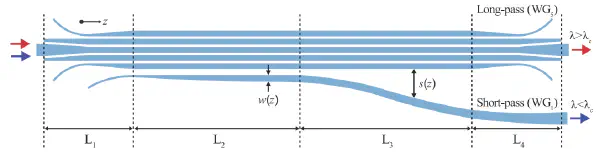
In our latest work published in Journal of Lightwave Technology (JLT), we introduce a new way to design and build ultra-broadband silicon photonic filters using adiabatic optimization of coupled waveguides.
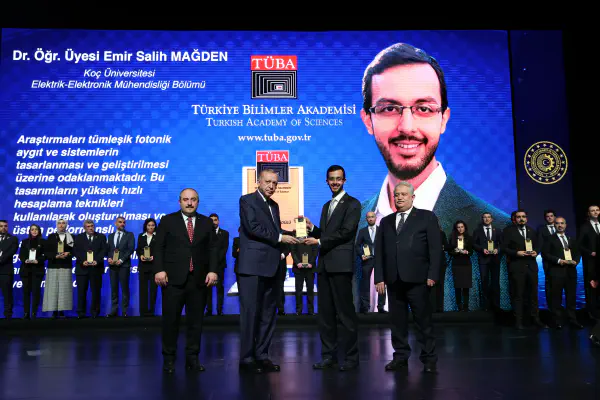
Prof. Emir Salih Magden has been awarded the 2021 GEBİP (Outstanding Young Scientist Award) by the Turkish Academy of Sciences (TÜBA). The award ceremony was held at the Presidential Complex in Ankara on December 28, 2021. Pictured is President Recep Tayyip Erdogan presenting the award to Prof. Magden.
The TÜBA-GEBİP program, established in 2001, is one of Turkey’s most prestigious honors for academics. It aims to support brilliant and promising young scientists younger than 40 who have distinguished themselves through their research. The program provides awardees with financial research funds and academic support for a period of three years, fostering a synergistic environment for the next generation of researchers to contribute to the scientific development of the country.
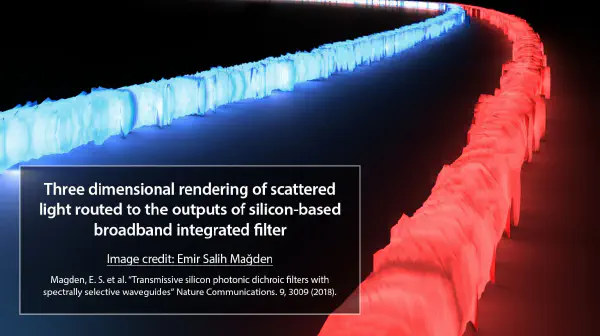
Our work on integrated broadband optical filters, now published in Nature Communications, provides a novel design and demonstration of optical filters that can simultaneously achieve broadband response and a sharp roll-off. The lead author of the paper describing integrated filter design and measurements is Prof. Emir Salih Mağden, along with colleagues from MIT’s Research Laboratory of Electronics. The article is featured on MIT’s homepage on August 3rd 2018.
Pictured is a 3D-render of scattered light from the integrated waveguides comprising the filter, captured at two different wavelengths directed towards the two separate output ports of the filter.
The Scientific and Technological Research Council Of Turkey (TUBITAK) recently announced that Prof. Emir Salih Magden has been awarded the Career Development Grant (TUBITAK 3501). The grant is one of 7 awarded this year in the Electrical/Electronics/Informatics research category.
The grant will cover the development, fabrication, and characterization of next-generation integrated photonic devices for a period of 36 months.
From TUBITAK homepage: “The Scientific and Technological Research Council of Turkey (TUBITAK) is the leading agency for management, funding and conduct of research in Turkey. It was established in 1963 with a mission to advance science and technology, conduct research, and support Turkish researchers. The council is an autonomous institution and is governed by a scientific board whose members are selected from prominent scholars from universities, industry, and research institutions.”
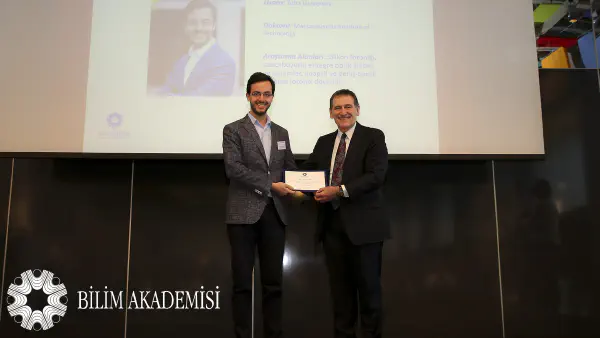
Prof. Magden is one of the 39 recipients of Science Academy’s Young Scientist Award (BAGEP 2018), and one of the 3 recipients in the field of electrical engineering. The awards ceremony was held at Bilgi University on April 27th 2018. Pictured is Koç University President Prof. Umran İnan presenting the award to Prof. Mağden.
The Science Academy rewards the most brilliant and promising academics younger than 40 with the prestigious Young Scientist Award program. The BAGEP program provides award-winning young academics with research funds for a period of two years.
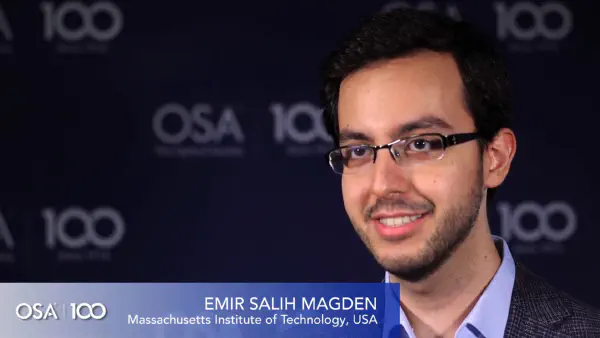
Prof. Magden shares why he finds working with light so inspiring, in this interview with the Optical Society of America (OSA). The interview was filmed at Optical Fibers Conference (OFC) held in San Diego Convention Center, San Diego, California, USA.
The interview is a part of the 100th anniversary celebrations of OSA’s Celebrating All Members (CAM) events where frequent attendees of meetings and congresses get an opportunity to share their stories. Click here to access the full video.