Linked Publication
Integrated optical filters are crucial, but achieving truly broadband performance (think >100 nm) with low loss, sharp edges, and design flexibility has been a major hurdle. Rings, MZIs, and AWGs often hit bandwidth ceilings or FSR limitations, while other approaches can be lossy or complex.
What if you could bypass these limits?
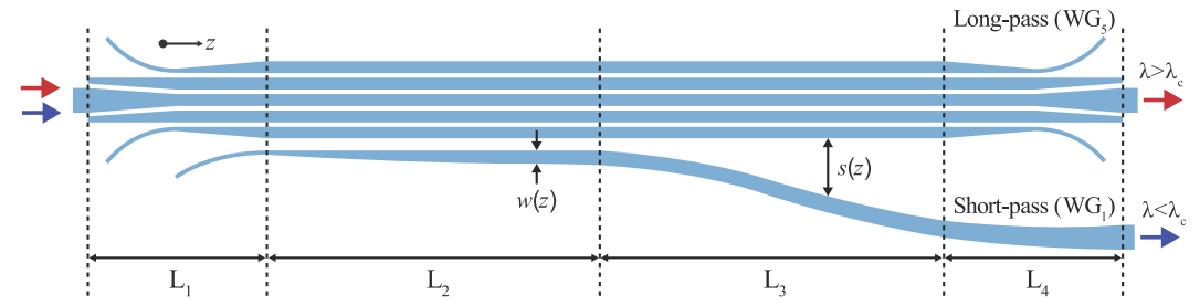
In our latest work published in Journal of Lightwave Technology (JLT), we introduce a new way to design and build ultra-broadband silicon photonic filters using adiabatic optimization of coupled waveguides.
The Core Idea#
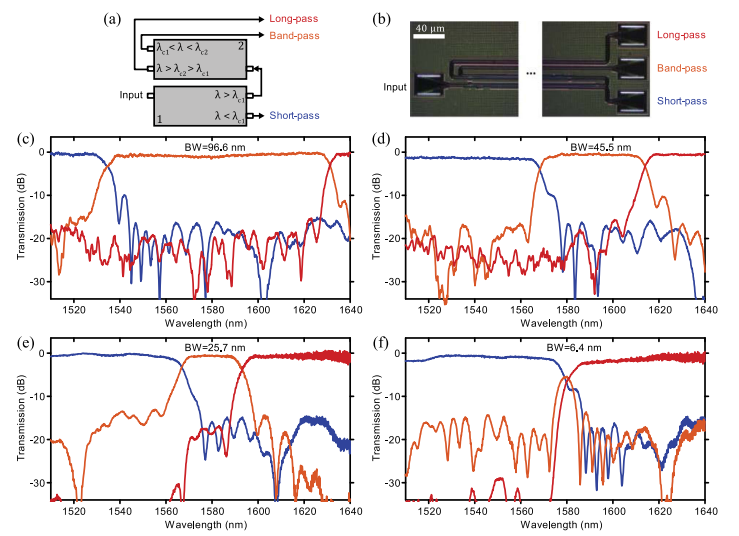
We’ve developed a method to create highly efficient, compact “single-cutoff” filters that cleanly split light into short-pass and long-pass transmission outputs. The magic happens when we cascade two of these filters. By independently tuning the cutoff point of each stage (simply by adjusting waveguide geometry!), we can precisely define the edges of a band-pass filter.
This unlocks unprecedented flexibility:
- Massive Bandwidths: Experimentally, we’ve demonstrated band-pass filters up to 96.6 nm wide!
- Clean Performance: These filters feature inherently flat-top transmission, low insertion loss (< 1.5 dB), and good extinction ratios (> 15 dB).
- Compact & FSR-Free: Our designs are compact (~1 mm) and completely free from FSR limitations.
We believe this approach opens the door for next-generation photonic systems – enabling ultra-wideband WDM across S+C+L bands, advancing on-chip spectroscopy, and creating new possibilities in multi-band sensing.